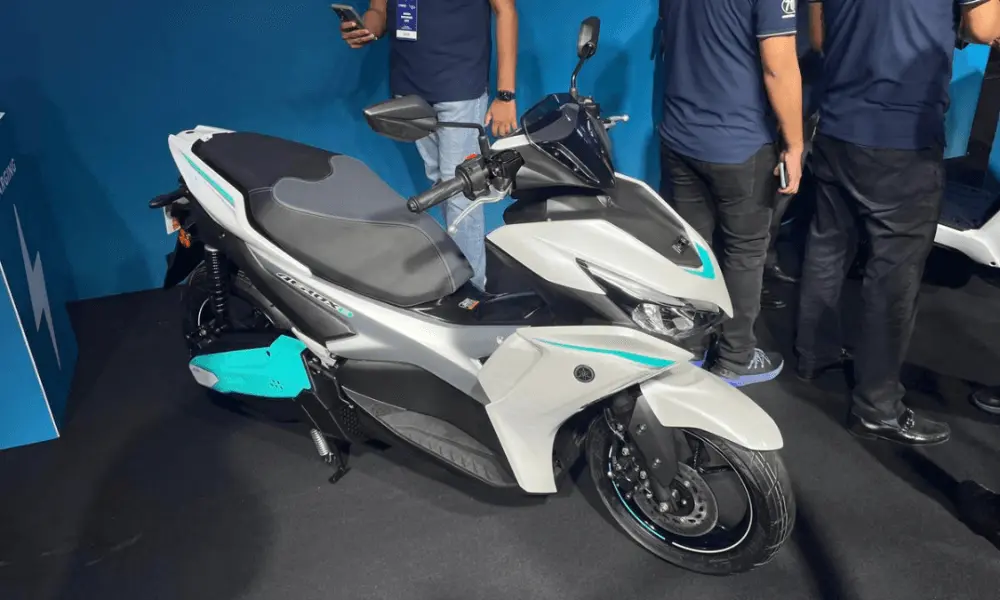
The Yamaha Aerox E brings Yamaha’s sporty maxi-scooter attitude to electric mobility.
It keeps the aggressive looks of the Aerox family.
Under the fairing sits an electric motor and removable battery setup.
This scooter aims to deliver quick city acceleration, practical daily range and easy home charging.
In this review I explain the Aerox E for Indian riders.
I use simple English and short sentences.
I cover design, range, battery, charging, ride, features, ownership and value.
At the end you get a quick spec table, FAQs and a final verdict.
Quick specification table — Yamaha Aerox E (typical revealed figures)
| Item | Typical detail |
|---|---|
| Motor (peak) | 9.4 kW (peak) |
| Torque (peak) | ~48 Nm |
| Batteries | Dual removable ~3.0 kWh cells (total ~6.0 kWh) |
| Claimed combined range | ~100–110 km (combined cycle) |
| Ride modes | Eco / Standard / Power (+ Boost) |
| Brakes | Disc front & rear; single-channel ABS |
| Safety | Traction control, battery management system |
| Display | 5-inch TFT with Bluetooth |
| Special | Removable batteries, reverse gear, keyless start (trim dependent) |
| Target launch | India 2025–2026 (official timing and price at launch) |
Quick verdict — one line
The Yamaha Aerox E is a sporty electric maxi-scooter that blends brisk performance with detachable batteries and urban practicality.
It is best for riders who want instant acceleration, modern features and easy home charging.
Why the Aerox E matters in India
Electric two-wheelers are growing fast in India.
But many buyers still worry about charging and range.
The Aerox E tackles both with detachable batteries.
You can remove the cells and charge them at home.
That beats the need for a dedicated wall box for many apartment owners.
Yamaha also brings a performance focus.
This scooter is not only about commuting.
It targets riders who want sporty looks and quick overtakes in traffic.
Design and first impressions
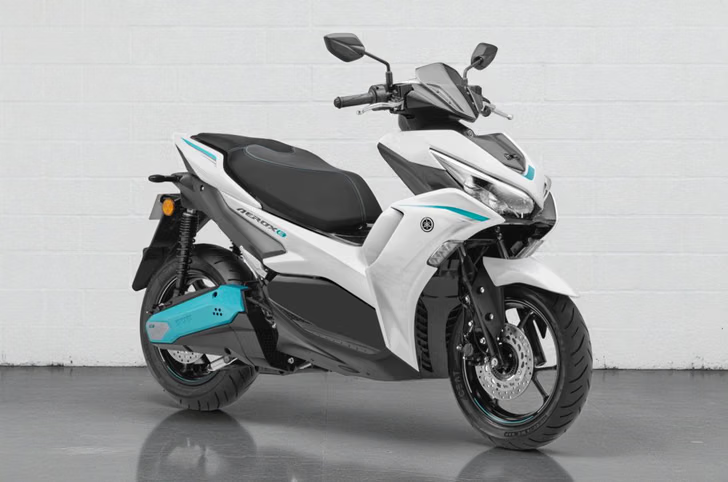
The Aerox E looks like a scaled maxi-scooter.
Sharp lines and aggressive angles give it a strong road presence.
The front fairing is bold. The LED headlamp cluster looks modern and focused.
The body has sharp creases and aerodynamic panels.
The seat is long and steps up for a sporty feel.
Range-finder riders will like the wide tyres and muscular rear end.
Overall, it looks like a scooter you would pick if you care about style.
Also Read Kia EV6 Review 2025: Premium Electric Crossover With Long Range, Speed, and Style
Motor, batteries and claimed range
Yamaha fitted a strong motor to the Aerox E.
Peak power is around 9.4 kW for short bursts.
Peak torque is near 48 Nm.
That gives lively acceleration from standstill.
The Aerox E uses two removable batteries.
Each battery is roughly 3.0 kWh.
Together they add up to about 6.0 kWh usable capacity.
Yamaha quotes combined range in the 100–110 km band.
This is a realistic city figure if you use Eco or Standard modes.
Using Power or Boost modes will reduce range.
Real range also depends on rider weight, terrain and average speed.
Charging and battery convenience
The removable batteries are the Aerox E’s main practical benefit.
You can carry a battery into your flat or office.
You can charge from a normal household socket.
No wall box is strictly required for daily top-ups.
If you own two batteries, you can charge one while riding on the other.
This effectively doubles practical daily use.
Fast DC charging is not the scooter’s focus.
Public fast chargers will top up faster, but Yamaha designed the scooter for home convenience.
Thermal management and battery health systems help protect the cells during repeated charging.
Ride modes and throttle mapping
The Aerox E offers multiple ride modes.
Common modes are Eco, Standard and Power.
There is also a short-duration Boost function.
Eco limits power for maximum range.
Standard gives a balanced response.
Power opens full throttle for spirited riding.
Boost delivers a quick surge for overtakes.
Modes change throttle feel and regen levels.
Riders can choose what suits city traffic or a quick highway run.
Performance and real-world use
On the road the Aerox E feels quick.
Electric torque is immediate.
You get strong takeoffs from traffic lights.
Lane changes and urban overtakes feel effortless.
Top speed is sufficient for city and short expressway rides.
The chassis is larger than commuter scooters.
It is more stable at higher urban speeds.
The larger wheels and firmer suspension help stability.
Pillion comfort is reasonable for short rides.
Long two-up trips will feel sporty rather than plush.
Chassis, suspension and braking
Yamaha built the Aerox E on a maxi-scooter frame.
The swingarm and larger wheels give it good straight-line stability.
Front suspension is telescopic. The rear uses a monoshock.
Suspension is tuned to be firm yet compliant. It soaks small bumps but keeps the scooter controlled.
Braking is by disc at both ends.
Yamaha equips the Aerox E with a single-channel ABS system.
Traction control is present to manage wheel slip under hard acceleration.
These safety systems help when you ride fast in city traffic.
Practicality and storage
Under-seat storage is smaller than on some commuter scooters.
Battery packaging eats space under the seat.
You will still find useful compartments for a charger and small items.
A dedicated front tray or glove box may be present on some trims.
The removable batteries themselves are designed with handles to make them easy to lift.
They fit in the trunk of a car or in a hallway.
For many city riders this setup is more convenient than searching for a public charger.
Features and cockpit
The Aerox E sports a modern cockpit.
A five-inch TFT screen shows speed, battery state, range and ride mode.
Bluetooth pairing allows phone integration for navigation prompts and calls.
Keyless start may be offered on higher trims.
LED lighting is standard.
USB charging provision for phones is usually included.
Ergonomics are sporty. Controls are easy to reach.
The scooter has a reverse mode to help manoeuvre in tight spaces.
Overall feature content is premium for the electric scooter segment.
Safety and electronics
Yamaha included safety aids to manage the strong electric power.
Single-channel ABS helps prevent wheel lock on hard stops.
Traction control prevents rear wheel spin under heavy throttle.
Battery management software monitors cell temperature and state of charge.
This helps longevity and safety in hot Indian climates.
Yamaha also integrates protection circuits to reduce the risk of overcharge or deep discharge.
Pricing and launch expectations in India
Yamaha plans to launch the Aerox E in India as part of its electric push.
Early media reports suggested a premium price band.
Expect the scooter to sit above mainstream commuter e-scooters.
The target buyers will likely be urban professionals and enthusiasts.
Official India pricing will be announced at launch.
Consider total cost of ownership, battery warranty and dealer network when you decide.
Ownership, warranty and service
Yamaha will offer service support through its dealer network.
Battery warranty is an important factor.
Confirm the battery warranty term and coverage when you buy.
Removable batteries can lower running costs because you can charge at household rates.
Replaceable battery units may simplify future battery upgrades or swaps if Yamaha offers such programs.
Keep service records and follow recommended checks to protect resale value.
Pros and cons — short list
Pros
- Strong, instant electric acceleration for urban use.
- Detachable dual batteries for easy home charging.
- Sporty maxi-scooter styling and larger wheel stability.
- Practical features: TFT display, ride modes, boost and reverse.
- ABS and traction control for safer use.
Cons
- Reduced under-seat storage due to batteries.
- Public DC fast-charging is still limited in many cities.
- Real range falls with frequent use of Power/Boost modes.
- Price likely higher than basic commuter EVs; value is for performance buyers.
FAQs — common questions Indian buyers will ask
Q — What is the real-world range of the Aerox E in Indian traffic?
A — Expect around 80–100 km in mixed city riding. Heavy use of Power or Boost modes reduces range. Rider weight, speed and stop-start traffic also affect numbers.
Q — Can I charge the batteries at home without a wall box?
A — Yes. The removable batteries are designed to charge from a regular household socket. This makes them convenient for apartment owners.
Q — How long does a full charge take?
A — Home charging time per battery depends on the charger and battery state. Small household chargers will take several hours per battery. Fast DC public chargers will top up faster, but the Aerox E is optimized for removable battery convenience.
Q — Are the batteries easy to lift for older riders?
A — Yamaha designs battery packs with handles and reasonable weight. However, lifting capability varies by user. Check the actual weight in the showroom and try lifting a battery before purchase.
Q — Does Yamaha offer battery swap or exchange programs?
A — Yamaha has not announced a national swap program as a standard. The initial focus is on removable batteries charged at home. Future swap programs may be evaluated depending on market demand.
Q — Is the Aerox E safe in heavy rain and monsoon conditions?
A — Yamaha designs battery housings and electrical wiring to withstand normal wet conditions. Ride carefully in heavy rain as road grip and visibility are affected. Use traction control and maintain safe speeds.
Final verdict — is the Aerox E right for you?
The Yamaha Aerox E is a compelling choice if you value sportiness and easy home charging.
It is ideal for young professionals, style-conscious commuters and riders who want extra acceleration in city traffic.
The removable dual batteries remove a big barrier for many Indian buyers.
They make everyday charging easy even without a wall box or garage.
If you need maximum under-seat storage or you ride very long continuous highway distances every day, look at alternatives with larger fixed batteries.
For urban riders who want a premium electric maxi-scooter with modern features, the Aerox E is an attractive and practical option.